Bierens Sales
Automation
Researching how company data, business criteria and AI can support a reliable, secure and reviewable Sales assessment process.

Rabi Arbi
Bierens Group · Veghel · 25 September 2026
Project assignment
Context
Bierens Incasso Advocaten B.V. is an organization located in Veghel, they specialize in debt collection and legal services and support to companies. Bierens operates not only nationally but handles also international cases. Within these services, incoming requests need to be assessed whether the case is suitable or relevant for further processing by the organization.
Bierens receives a large number of requests (approximately 20,000 per year) from different types of companies and countries, these applicant requests contain information such as the name of the company and the description of the case. While additional information about the company is available on Bierens internal system, currently assessing these requests requires employees to manually search for the company on that internal system to determine whether the applicant case fits Bierens target group and commercial focus. Because not every incoming request is equally relevant, there is an opportunity to support this initial assessment with automation and the available company data. some case descriptions can be too long which can result in employees spending a lot of time reading irrelevant information so a summarization tool could be helpful in this case.
The assignment therefore focuses on the sales process and the initial classification of incoming requests. The goal of the project is to investigate how available information can be used to automate the filtering process by automatically classifying each request at different prioritization levels. This will be accomplished by building an automated workflow that can combine the company data from the internal system of Bierens and the case descriptions. This flow is not intended to replace legal decision making but rather support the business-oriented assessment and help employees identify the relevant cases more efficiently and consistently.
For this assessment, automation process and artificial intelligence are necessary to create a more efficient flow of incoming requests. Automation platforms such as n8n could make it possible to connect different systems and automate parts of the decision
Process. While AI and large language models (LLMs) can additionally be investigated for tasks involving unstructured information, such as interpreting or summarizing case descriptions. The project investigates how these technologies can be combined to create a practical solution and improve efficiency for Bierens.
The reason for this assignment is to improve the way the incoming requests are processed at Bierens. By using AI and automation, this project aims to reduce manual work and support employees in assessing requests more effectively.
Goal of the project
The current sales process at Bierens requires employees to retrieve company information and read all the case descriptions manually. With approximately 20,000 requests per year, this requires a considerable amount of manual work which can make the initial assessment very time-consuming.
The main goal of this project is to investigate, design and develop a solution that supports the initial assessment of incoming requests using automation, available company data and AI. The system should be able to retrieve company information like credit score, how many people work there, whether they are active or inactive…. Etc.
This information will be processed in combination with the refined case description to help classify the cases into different priority levels that are used by Bierens.
The desired outcome is an automated workflow in which an incoming request is enriched with relevant company data where it is defined based on specific business criteria. The role of AI will be to support the processing of unstructured information, for example by summarizing long case descriptions and identifying missing or insufficient information. The final classification will help employees of Bierens with information that supports their decision on whether the case is relevant or not rather than replace their judgment.
The project should reduce unnecessary manual and repetitive work and make the sales process more efficient and consistent. The solution will provide Bierens with insights into the possibilities and the limitations of using automation and AI within the sales process. Based on these results, the project should deliver a working solution that supports the Sales process and provides a foundation for further development and improvement within Bierens.
The assignment
The assignment is first to research whether it is possible to automate the sales process of cases that come in daily, based on company data and the information provided at the applicant's request. After that, a solution will be designed, developed, and evaluated to automate the initial assessment. Research will also be conducted to determine whether an automation platform such as n8n is the best option to use for this project. The automation platform will combine the incoming case information with the company data that is being retrieved from Bierens internal system. AI will be used for structuring information such as in summarizing descriptions and detecting insufficient information.
The solution should at minimum be able to retrieve relevant company information, process the case description, and classify a request according to the priority levels used by Bierens. The classification must be based on agreed business criteria and should provide sufficient information for employees to understand and review the result. The solution should support employees in their assessment rather than replace human decision-making
Scope
| The project includes: | The project does not include: |
|---|---|
| Researching the current sales process at Bierens | Replacing the complete existing sales process |
| Investigating available company and requesting data that can be used for assessment | Large-scale organization-wide rollout and long-term maintenance of the solution. |
| Designing and developing a solution for automated sales process and classification | Deployment and organization-wide implementation of the solution |
| Retrieving relevant company information from Bierens' internal systems | Replacing legal or final human decision-making |
| Using defined business criteria to support the classification/prioritization of requests | Defining Bierens' commercial or legal acceptance criteria without stakeholder input |
| Investigating/using AI for unstructured case information, such as summarization and detecting insufficient information | Allowing AI to independently make final legal decisions |
| Testing and evaluating the solution | — |
| Documenting the solution and providing recommendations for further development | — |
Conditions
Access to relevant data: Access must be provided to the necessary company and request data within Bierens' internal systems. The available data and fields first need to be investigated and validated before they can be used in the solution.
Access to internal systems: The project depends on the possibility of retrieving relevant company information from Bierens' internal systems. The available integration methods and technical restrictions still need to be determined.
Business criteria: The criteria used by employees to assess and prioritize incoming requests must be identified and validated with the relevant stakeholders before they can be implemented.
Technology: n8n is a potential automation platform for the project, but its suitability will first be investigated rather than assumed.
AI/LLM availability: If an LLM is used, an appropriate model and environment must be available and comply with Bierens' technical and privacy requirements.
Privacy and security: Client, company and case information must be handled according to Bierens' security and privacy requirements. Sensitive information should not be sent to external AI services without approval.
Stakeholder availability: Relevant employees must be available to explain the current process, establish requirements and business criteria, and evaluate the solution.
Ethical considerations
Because the solution may use AI to process company, customer and case information, security, privacy and responsible use of AI are important requirements within this project.
A main consideration is where company and personal data is processed and stored. If an external LLM is used, preference will be given to a solution where data can be processed and hosted within the European Union or European Economic Area (EU/EEA). Before selecting an AI provider, the project will investigate the hosting location, data-processing location, data retention, subprocessors, applicable jurisdiction, security measures and whether submitted data can be used for model training. Sensitive Bierens information should not be sent to an AI service unless the service has been reviewed and approved by Bierens.
Data minimization will be applied. Only information that is necessary for a specific AI task should be provided to the model. Where possible, personal or sensitive information should be removed or anonymized before AI processing. API keys, credentials and sensitive information must also be protected and should not appear unnecessarily in prompts, workflow logs or documentation.
AI will only be used where it provides a clear benefit, for example for processing unstructured text. Deterministic Bierens business rules should remain separate from AI-generated judgments. AI output should not automatically be considered correct. Important information should be based on verified sources, and uncertain or incomplete results should be forwarded for human review.
The solution should also be transparent and explainable. Sales employees should be able to understand what information was used, whether AI was involved, and which business rules contributed to a classification. AI should support employees rather than independently make final decisions.
During the project, possible AI solutions will therefore be evaluated based on security, privacy, EU/EEA hosting and processing, data retention, reliability, performance and cost. Ethical and privacy considerations will be included when selecting the LLM and designing the final solution.
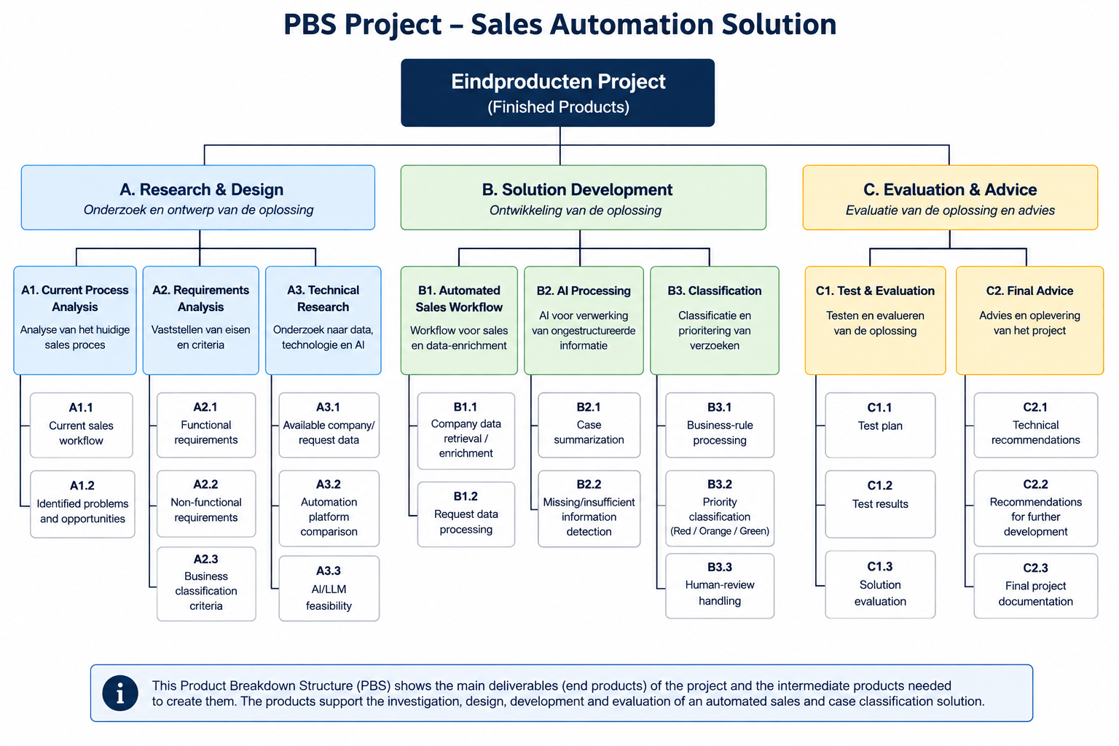
Finished products
| Category | Product | Deliverables |
|---|---|---|
| Research & design | Current process analysis | Current sales workflow; identified problems and opportunities |
| Research & design | Requirements analysis | Functional requirements; non-functional requirements; business classification criteria |
| Research & design | Technical research | Available company/request data; automation platform comparison; AI/LLM feasibility |
| Solution development | Automated Sales workflow | Company data retrieval / enrichment; request data processing |
| Solution development | AI processing | Case summarization; missing/insufficient information detection |
| Solution development | Classification | Business-rule processing; priority classification (Red / Orange / Green); human-review handling |
| Evaluation & advice | Test & evaluation | Test plan; test results; solution evaluation |
| Evaluation & advice | Final advice | Technical recommendations; recommendations for further development; final project documentation |
Research questions
Main research question
How can the current sales process and initial assessment of incoming requests at Bierens be automated using available company data, business criteria, and AI while maintaining a reliable, secured and reviewable classification process?
Sub-questions
- SQ 1
How is the current sales process performed at Bierens, and which parts of this process can potentially be automated?
- SQ 2
Which company and request data is available within Bierens' systems, which information is relevant for the initial assessment of a case, and how is this data stored and protected?
- SQ 3
Which business criteria are currently used by Bierens to determine the priority and relevance of an incoming request, and why are these criteria important for the assessment?
- SQ 4
Which technical approach is most suitable for implementing the automated sales process, and which steps should be handled by automation, business rules, or AI/LLMs? To what extent is an automation platform such as n8n suitable for connecting and managing these different steps?
- SQ 5
How can AI/LLMs support the processing of unstructured case information, such as summarizing long descriptions and identifying missing or insufficient information, and where should AI be used within the sales process?
- SQ 6
If an LLM is used within the solution, which LLM and hosting approach is most suitable for Bierens considering performance, cost, security, privacy, and preferably European data hosting?
Approach & planning
Approach
This project will be a combination of waterfall and agile, the first phase will follow a more structured approach, starting by analyzing the current sales process, identifying the requirements, investigating what kind of data is available and researching the most suitable technologies. These activities will be a crucial part before starting developing a solution.
During the development phase, Agile will be the approach to move forward with this project. The solution will be developed in smaller parts, such as company data retrieval, case description processing and classification. Each part will be tested and reviewed by the stakeholders at Bierens before going forward. Regular feedback will be crucial to adjust things like requirements or priorities when necessary.
Towards the end phase of this project, these different components will be combined into a single solution (dashboard) where employees of Bierens can see the incoming requests in a priority list and processed descriptions. The
solution will be tested against the established requirements. The results and limitations will then be evaluated and documented, followed by recommendations for possible further development within Bierens.
Test approach
Testing will be performed during development of the solution rather only at the end of the project. Each main part of the project will be tested separately first, for example the retrieval of company data, processing of case descriptions, classification logic, and AI-supported functions. Then when combined, another testing round will be taking place.
The solution will be tested using different request examples that represent the requests Bierens normally receives, the results of the system will be compared with the expected results with the assessment of employees as well. Cases with missing data, unclear or long description, and incorrect classification will also be tested.
The AI functions will also be tested to check whether their ability to summarize description is up to standard or whether it recognizes when important information is missing. If the AI result is unclear or uncertain, the case should be the AI system forwarding the case and notifying the employees for further review.
During development, important parts of the workflow, such as n8n configuration, business rules, scripts, AI prompts, will also be reviewed by collaborating with the Dev team of Bierens group. There feedback will be used to improve the solution.
Research methods
1. Interview – Sales employees
Interviews have been conducted with Charelle Rooijackers, a customer sales support officer, and Laurens van der Lof, Head of Marketing, Sales & Business Innovation, to understand the current sales process. During the interviews, Charelle explained how incoming requests are currently handled, what information Sales look at, how they determine whether a request is interesting, and which problems they experience in the current process. Laurens provided further information about the desired situation, the expectations for the project, and how the sales process could potentially be improved. These interviews helped identify where manual work takes place, what the business needs from the solution, and which parts of the process could potentially be improved through automation.
2. Observation / Process exploration
After a demonstration by the sales support officer on how the sales process is currently being managed and observing how Bierens handles those incoming requests, it became clearer which steps are performed manually, which systems are used, and where information is missing or unclear. This method is used to compare what was explained during the interviews and how the process works in practice.
3. System and data analysis
The internal systems used by Bierens are being explored to understand what company information is available and how employees currently use this information during an assessment. This includes investigating available information such as company status, credit score, employee count, and other relevant company attributes where available. The purpose is to determine which data could potentially be used by the automated workflow.
4. Literature / Technology research
Research is going to be conducted to investigate possible technologies for implementing the solution. This includes researching automation platforms such as n8n and the see what options are suitable when it comes to AI/LLM for the solution. The research will conclude a compression of technical possibilities and support the decision on which approach is most relevant for the solution.
5. Prototyping and testing
During the development phase, a solution will be created and tested in iterations. Different approaches to retrieving data, processing case descriptions, and classifying requests will be tested. The results will be discussed with relevant employees to determine whether the output matches how cases should be assessed in practice.
| Research question | How will I research this? | DOT fields | Methods |
|---|---|---|---|
| 1. How is the current Sales process performed at Bierens, and which parts of this process can potentially be automated? | This sub-question investigates how Sales currently handles incoming requests. I will investigate the steps employees perform, which systems they use, where manual work takes place and which parts could potentially be automated. Interviews and observations will be compared with the documented process. The findings will be reviewed with Sales to check whether my understanding is correct. |  Field  Workshop  Showroom | Field: Interview, Observation Workshop: Process Mapping Showroom: Expert Review |
| 2. Which company and request data is available within Bierens' systems, which information is relevant for the initial assessment, and how is this data stored and protected? | This sub-question investigates what information is available from the website request and Bierens' internal systems. I will explore the available fields and investigate which information Sales actually needs. I will also investigate how the data is accessed, stored and protected. The proposed data requirements will be validated with relevant Bierens employees. | Field LabShowroom | Field: Interview / System Exploration Lab: Data Analysis Showroom: Expert Review |
| 3. Which business criteria are currently used by Bierens to determine the priority and relevance of an incoming request, and why are these criteria important? | This sub-question investigates the existing criteria used by Bierens. I will collect information through interviews and internal documentation and translate the criteria into structured business rules. The interpreted rules will then be reviewed with Sales and other relevant experts to make sure they have been understood correctly before they are implemented. | Field LibraryShowroom | Field: Interview Library: Document Research Showroom: Expert Review / Peer Review |
| 4. Which technical approach is most suitable for implementing the automated Sales process, and which steps should be handled by automation, business rules or AI/LLMs? To what extent is n8n suitable? | This sub-question investigates how the solution should technically be built. Existing technologies and documentation will be researched, including n8n. Based on this research, different technical approaches will be designed and small prototypes will be created to test important parts. The proposed architecture will then be reviewed with technical stakeholders at Bierens. | LibraryWorkshopShowroom | Library: Literature Study / Available Product Analysis Workshop: Prototyping, IT Architecture Sketching Showroom: Expert Review |
| 5. How can AI/LLMs support the processing of unstructured case information, such as summarizing long descriptions and identifying missing information, and where should AI be used? | This sub-question investigates where AI provides value and where normal automation or business rules are more suitable. Research will first be done into possible AI approaches. I will then create and test prototypes for tasks such as summarization and identifying missing information. The results will be reviewed to determine whether the AI output is useful and reliable enough for Sales. | LibraryWorkshopLab | Library: Literature Study Workshop: Prototyping Lab: Component Test / Benchmark |
| 6. If an LLM is used, which LLM and hosting approach is most suitable for Bierens considering performance, cost, security, privacy and preferably European data hosting? | This sub-question compares possible LLMs and hosting approaches. Information will be collected about performance, cost, privacy, security, data retention, hosting location and integration possibilities. Suitable options will be tested with representative inputs where possible. The results will also be evaluated from a privacy and ethical perspective before making a recommendation. | LibraryLabShowroom | Library: Available Product Analysis / Literature Study Lab: Benchmark Test Showroom: Ethical Check / Expert Review |
Learning outcomes
| Learning outcome | How I will demonstrate it | Possible evidence / professional products |
|---|---|---|
| Analysis | I will analyze the current sales process, the problems experienced by Sales, the company data available, and the requirements for automating the process. | Interview results, current process analysis, requirements analysis, data/system analysis |
| Advice | I will research and compare possible solutions and provide advice on which technologies and approaches are suitable for Bierens. | Technology comparison, n8n research, AI/LLM research, final recommendations |
| Design | I will design the architecture and workflow for the automated sales and classification process before and during development. | Architecture diagram, n8n workflow design, data flow, classification logic, AI prompt design |
| Realisation | I will develop a working solution that demonstrates how incoming requests can be enriched, processed and classified. | Working Solution, n8n workflows, scripts/integrations, AI functionality |
| Manage & Control | I will plan and monitor the project, validate requirements with stakeholders, test the Solution and use feedback to improve it. | Project plan, planning, test plan/results, feedback, stakeholder reviews, portfolio/FeedPulse |
Breakdown of the project
| Phase | Main activities |
|---|---|
| 1. Orientation & Problem Analysis | Understand Bierens' sales process, interview stakeholders, identify current problems and define the project scope. |
| 2. Requirements & Data Research | Determine functional and non-functional requirements, investigate available company/request data, and identify the business criteria used for prioritization. |
| 3. Technical Research & Design | Research suitable automation technologies such as n8n, investigate AI/LLM possibilities, and design the workflow and system architecture. |
| 4. Solution Development – Iteration 1 | Build the basic workflow, process incoming request data and connect/retrieve relevant company information. |
| 5. Solution Development – Iteration 2 | Implement the classification logic and AI functionality, such as summarizing case descriptions and detecting insufficient information. |
| 6. Testing & Improvement | Test the complete workflow with representative cases, compare results with expected assessments, collect stakeholder feedback and improve the Solution. |
| 7. Evaluation & Completion | Evaluate the Solution against the requirements, document results and limitations, provide recommendations and complete the final project documentation. |
Time plan
| # | Phasing | Effort | Start | Ready |
|---|---|---|---|---|
| 1 | Orientation & Problem Analysis | 2 weeks | Week 1 | Week 2 |
| 2 | Requirements & Data Research | 2 weeks | Week 2 | Week 4 |
| 3 | Technical Research & Design | 2 weeks | Week 4 | Week 6 |
| 4 | Solution Development – Iteration 1 | 3 weeks | Week 6 | Week 9 |
| 5 | Solution Development – Iteration 2 | 3 weeks | Week 9 | Week 12 |
| 6 | Testing & Improvement | 3 weeks | Week 12 | Week 15 |
| 7 | Evaluation & Completion | 3 weeks | Week 15 | Week 18 |
| 8 | Portfolio & Documentation | Throughout project | Week 1 | Week 18 |
Project organization
Team members
| Name | Abbr. | Role/tasks | Availability |
|---|---|---|---|
| Rabi Arbi | RA | Intern, AI researcher and project developer. Responsible for research, requirements, design, development, testing and documentation of the solution. | Full-time during internship |
| Laurens van der Lof | LVL | Company supervisor and Head of Marketing, Sales & Business Innovation. Provides guidance on the business needs, sales process, project direction and desired outcome. Help validate whether the developed solution supports Bierens' business goals and the needs of the Sales department. | Weekly feedback meeting and when needed |
| Joris Engel | JE | Project leader. Provides project-related and technical/business guidance and feedback on important project decisions. | When needed / planned meetings |
| Charelle Rooijackers | CR | Sales stakeholder. Provides information about the current sales process, assessment of incoming requests and practical requirements from Sales. | When needed for interviews, validation and testing |
Communication
During the project, regular communication will take place with the company supervisors and other relevant stakeholders. A weekly meeting of approximately 30 minutes will be held with the company supervisor to discuss the progress of the project, current tasks, questions, problems and next steps. Additional communication can take place when needed.
Communication with Sales employees and other stakeholders will mainly take place through interviews, feedback sessions and demonstrations. These moments will be used to understand the current process, validate requirements and business criteria, and collect feedback on the solution.
Communication with the Fontys internship supervisor will take place during scheduled meetings and feedback moments. These meetings will mainly focus on the progress of the internship, research, learning outcomes, portfolio and project documentation.
Important feedback, decisions and agreements will be documented so that they can be used as evidence and referred to later in the project.
Test environment
The solution will be developed and tested in a controlled environment. During development, test data can be used to safely test individual parts of the workflow without affecting the current Sales process.
An important requirement of the project is that the final solution must also work with live data from Bierens. Therefore, after the main parts of the solution have been tested, the n8n workflow and Sales assignment Tool will also be tested with approved live data and connections to the required internal systems.
Because the solution works with company and personal information, security and data protection are important throughout the project. Only data that is needed for the Sales automation should be processed. Access to live data and internal systems will be limited to authorized users.
The environment will include the n8n workflow, Sales assignment Tool, connections to approved Bierens systems, and AI/LLM components where needed. Before using an AI model with live data, it must be checked where the data is processed and stored and whether this follows Bierens' security and privacy requirements. Sensitive case information will not be sent to external AI services without approval from Bierens.
Passwords, API keys and other credentials will be stored securely and will not be placed directly in workflows, code or project documentation. Logging will also be checked to prevent sensitive information from being stored unnecessarily.
Testing will focus on whether the complete solution works correctly, safely and reliably with live Bierens data. Different situations will be tested, such as missing company information, failed connections, long or unclear case descriptions and incorrect or unexpected AI output. Problems found during testing will be corrected before the solution is considered ready for use.
Configuration management
The solution will mainly be developed and managed within n8n. During development, different versions of the workflows will be saved so that changes can be tracked, and an earlier version can be restored if needed.
The workflows will be organized and clearly named to make it easy to understand which version is being developed or tested. Important stages of the workflow can be exported and saved separately, for example:
Solution v0.1 → Solution v0.2 → Tested Solution → Final Solution v1.0
Sensitive information such as passwords, API keys and other credentials will not be included in exported workflow files or project documentation. Credentials will be managed securely within the available n8n environment.
For the scope of this solution, a more advanced version control or branching strategy is not required.
Finance & risks
Cost budget
The project focuses on developing a working solution, so no large project budget is expected. Existing hardware and systems provided by Bierens will be used where possible. The main possible costs are related to the automation platform, AI/LLM usage, hosting, or other services that may be required during development.
n8n is currently being considered as the main automation platform. The exact costs will depend on the environment and setup used by Bierens. If additional paid tools or services are required during the project, these will first be discussed with the company supervisor.
| Cost | Expected cost |
|---|---|
| Hardware/laptop | Provided by Bierens |
| n8n | Depends on chosen setup |
| AI/LLM | Depends on selected solution |
| Internal systems | Provided by Bierens |
| Other software | To be determined if required |
Risks and fall-back activities
| Risk | Prevention activities included in plan | Fall-back activities |
|---|---|---|
| No or limited access to required company data | Identify the required data and permissions early and discuss access with the responsible employees. | Use anonymized or example data to continue development until access is available. Testing with approved live Bierens data will take place before the final solution is delivered. |
| n8n is not suitable for a specific part of the solution | Research the capabilities and limitations of n8n and test important connections early in the project. | Adjust the workflow design. If a function cannot be handled by n8n, investigate another approved component for that specific function while keeping n8n as the main automation platform. |
| AI results are inaccurate or inconsistent | Test the AI with different case descriptions and keep business rules clearlyseparate from AI decisions. | Use AI only for suitable tasks and send uncertain or unclear cases to Sales for human review. |
| Sensitive company or personal data is exposed | Limit access to live data, use only the necessary information, securely manage credentials and follow Bierens' security and privacy requirements. | Stop the affected workflow or test, inform the supervisor responsible, investigate the cause and only continue when the issue has been resolved. |
| Business requirements or classification criteria are unclear | Regularly discuss and validate the requirements and red/orange/green classification criteria with Sales and the company supervisor. | Do not automate unclear criteria until they have been discussed and validated with the responsible stakeholders. |
| Company supervisor or important stakeholder is unavailable | Document important requirements, decisions and feedback and involve multiple relevant stakeholders during the project. | Contact another available stakeholder or expert within Bierens and continue with tasks that do not depend on the unavailable person. |
| Project takes longer than planned | Work in phases, prioritize the core functions and regularly check the project progress and planning. | Reduce lower-priority functionality and focus on delivering the core Sales Assessment Tool and automated n8n workflow. |
Solution Process Flow
Solution process flow
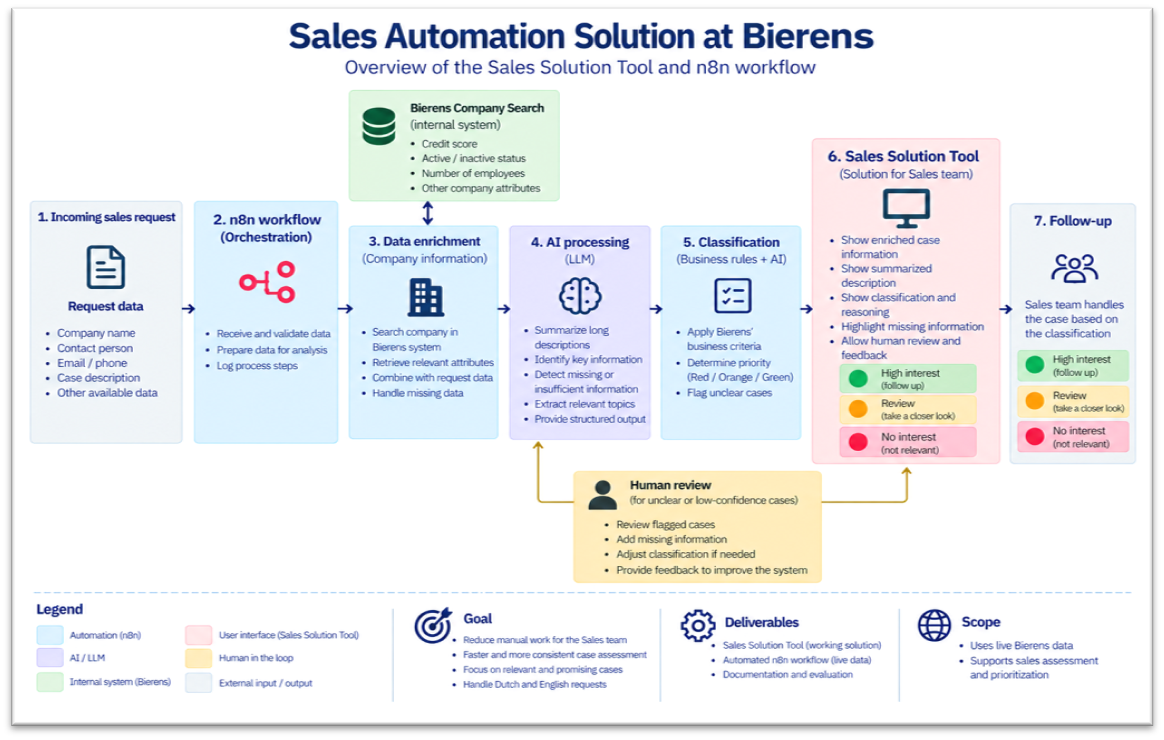
- 1
Incoming sales request
Request data
- 2
n8n workflow
Receive and validate data, prepare data for analysis and log process steps.
- 3
Data enrichment
Search the company in Bierens’ internal system, retrieve relevant attributes, combine with request data and handle missing data.
- 4
AI processing / LLM
Summarize long descriptions, identify key information, detect missing or insufficient information, extract relevant topics and provide structured output.
- 5
Classification
Apply Bierens business criteria, determine priority (Red / Orange / Green) and flag unclear cases.
- 6
Sales Solution Tool
Show enriched case information, summarized description, classification and reasoning. Highlight missing information and allow human review and feedback.
- 7
Follow-up
The Sales team handles the case: high interest — follow up; review — take a closer look; no interest — not relevant.
Human review
For unclear or low-confidence cases: review flagged cases, add missing information, adjust classification if needed and provide feedback to improve the system.
Bierens Company Search
Internal company information includes credit score, active / inactive status, number of employees and other company attributes.
Goal
Reduce manual work for the Sales team, enable faster and more consistent case assessment, focus on relevant and promising cases, and handle Dutch and English requests.
Deliverables
Sales Solution Tool (working solution), automated n8n workflow (live data), documentation and evaluation.
Scope
Uses live Bierens data and supports sales assessment and prioritization.